
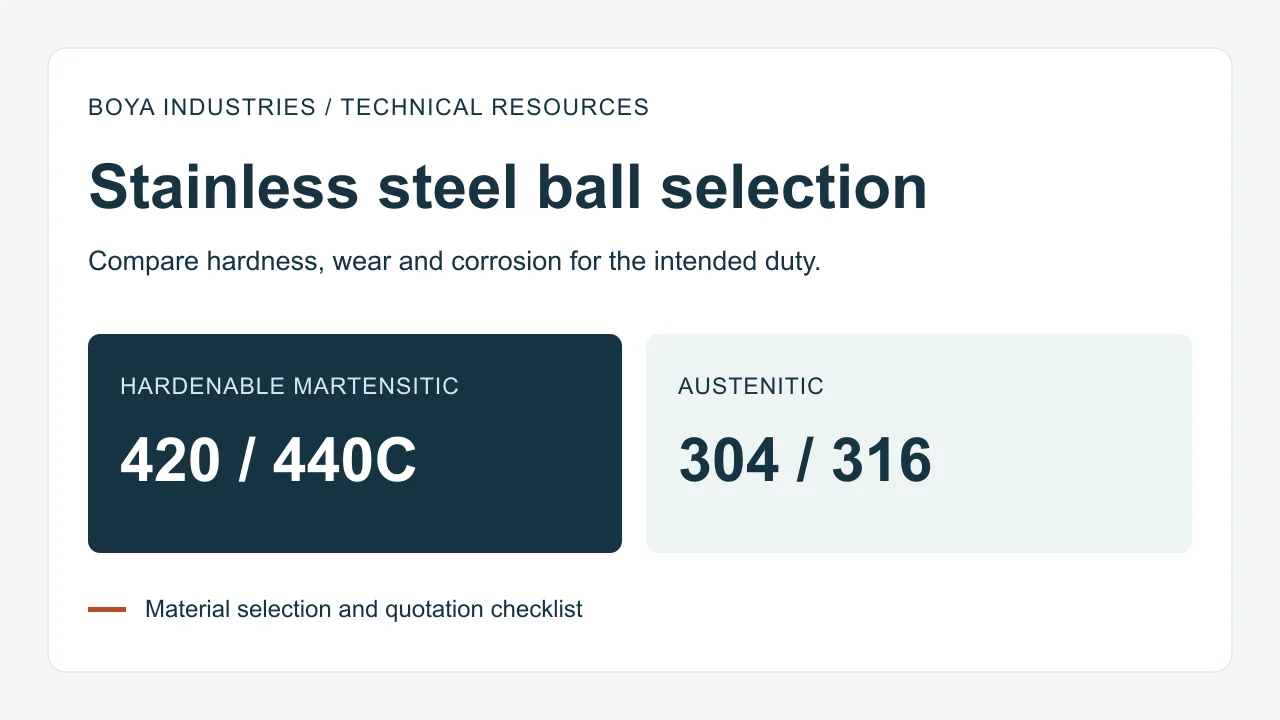
Start with the reason the ball might fail. For a loaded contact where wear or indentation limits service life, shortlist 420 or 440C and specify the condition and hardness of the finished ball. Where corrosion is the main concern and hardened contact performance is unnecessary, compare 304 and 316. The molybdenum in 316 generally improves resistance to chloride pitting and crevice corrosion relative to 304, but the actual fluid and operating temperature still matter.
Quick grade comparison
| Grade | When to consider it | What to verify before ordering |
|---|---|---|
| 420 | Hardenable martensitic steel for wear-sensitive contact in a compatible environment. | Exact designation, heat treatment, finished hardness, and fluid compatibility. |
| 440C | High-carbon martensitic steel when high hardness is important, as in certain rolling contacts. | Finished hardness and precision, contact load, lubrication, and corrosion exposure. |
| 304 | Austenitic steel for general-purpose service where corrosion exposure and contact loads are modest. | Cleaning chemicals, contact load, surface finish, and any magnetic response limit. |
| 316 | Molybdenum-alloyed austenitic steel to evaluate when chloride exposure makes 304 a poor fit. | Chloride concentration, temperature, trapped liquid, and whether the drawing requires 316 or 316L. |
420 or 440C for a hardened contact
Consider 420 when the component needs a hardened contact surface and its corrosion exposure is compatible with the grade. Evaluate 440C when the drawing calls for higher hardness or the contact has a demanding wear requirement. Both are martensitic stainless steels whose finished properties depend on heat treatment and surface condition. A purchase order that says only “420 stainless steel balls” leaves important details open. If the drawing calls for 420A, 420B, or 420C, give the exact designation and governing material specification, and require approval for any proposed substitution.
304 or 316 where corrosion drives the choice
304 and 316 are austenitic. Conventional hardening and tempering do not give them the same kind of hardened condition as 420 and 440C. Start with 304 for mild service if it meets the assembly’s mechanical needs. Consider 316 when the ball sees chloride-bearing water or cleaning fluids. In either case, include the strongest cleaner, maximum service temperature and whether liquid can sit in a crevice. A polished appearance alone provides little information about compatibility with the actual medium. Where the drawing calls for 304L or 316L, keep that low-carbon designation on the purchase order.
Three purchasing situations
- A check valve leaks after cycling. Establish whether the ball has worn, the seat has indented, or corrosion has damaged the sealing contact. Share the seat material, pressure, cycle rate, and service fluid. Evaluate the ball and seat together before selecting a harder alloy.
- A rolling contact operates in a damp housing. Compare 420 and 440C against the load, lubrication and condensation conditions. Ask for a confirmed hardness range and ball grade for your diameter. If both wear and corrosion are critical, qualify a sample in the intended assembly.
- A low-load component is washed with a chloride-bearing cleaner. Compare 304 and 316 against the actual concentration, temperature, contact time and rinse cycle. Review any locations where fluid can remain trapped. Use the customer’s acceptance test or a representative trial when the service is uncertain.
Build a quotation request suppliers can compare
- Alloy and condition. Give the exact designation and material standard if specified. For 420 or 440C, state the required heat-treatment condition and finished hardness range. Agree on how hardness will be measured and sampled at the ordered ball diameter.
- Dimensions and precision. Give the nominal diameter and units, the ball precision grade or drawing tolerances, and the governing acceptance standard if applicable. Specify any separate limit on diameter variation, deviation from spherical form, or surface roughness. The alloy designation and ball precision grade are separate fields.
- Operating duty. Provide the contact material, load or pressure, motion, lubrication, temperature and fluid chemistry. Include cleaning chemicals and the exposure cycle if relevant.
- Surface and verification. State the surface finish and cleaning or passivation requirement separately. If magnetic response matters, specify the limit and test method for the finished balls, since cold work can change the magnetic response of austenitic stainless steels. Identify any material documentation, lot traceability, or inspection results required at delivery.
- Quantity and approval. Give the sample and production quantities and identify any tests or sample approvals required before a production release. Ask the supplier to confirm the exact alloy, diameter, precision and finish combination in the quotation.
If the material is still open, ask suppliers to quote each proposed alloy on a separate line against the same drawing and service conditions. Have them identify any differences in heat treatment, inspection or surface treatment so you can compare the offers on the same basis.
Review supply options and request a quote
See BOYA’s stainless steel balls page for material and processing options. BOYA coordinates custom orders with manufacturing partners. The specific alloy, diameter, precision grade, condition and documentation are confirmed in the quotation and agreed order specification.
Request a stainless steel ball quotation with your drawing, service conditions and required quantity.