Product overview
Choose a stainless steel designation to suit the operating medium, then specify hardness, finish and dimensional tolerance. We supply stainless steel balls manufactured by our production partners to agreed order specifications.
Material & condition comparison
On small screens, scroll the table horizontally to see all columns.
| Material / condition | Characteristics | Typical applications |
|---|
| Hardenable 400-series grades · 420A / 420B / 420C / 440C | Martensitic grades selected for hardness and wear resistance after suitable heat treatment. Because 420A, 420B, 420C and 440C differ in composition and heat-treatment response, specify the required designation, target hardness and operating medium in your enquiry. | Bearings, valves and mechanical components requiring wear resistance. |
|---|
| 300-series grades · 302 / 304 / 304L / 316 / 316L | Austenitic grades selected for corrosion resistance and chemical compatibility; specify delivery condition. | Food-processing equipment, medical devices and chemical systems, subject to application requirements. |
|---|
| 316 / 316L · within the 300 series | Options for more demanding corrosion conditions; assess the medium, chlorides and temperature. | Marine, high-humidity and hygienic systems after suitability review. |
|---|
Read the 420, 440C, 304 and 316 selection guide ↗
Processing & surface options
Select an option to include it in your enquiry.
Materials & production options
Select an option to include it in your quotation request.
Product specifications
Current product specification| Diameter range | 0.5–150 mm |
|---|
| Precision grade | G10–G1000 |
|---|
| Material family | 400 series: AISI 420A / 420B / 420C / 440C; 300 series: AISI 302 / 304 / 304L / 316 / 316L |
|---|
| Performance considerations | Corrosion resistance and chemical compatibility by alloy; wear resistance for hardened grades; surface cleanliness specified by application. |
|---|
Provide material, diameter, grade and quantity for a specification-based quotation.
Include the diameter, tolerance, hardness, surface and inspection requirements from your drawing. The quotation and agreed order specification define the supply and acceptance requirements.
See our Steel Ball Size & Weight Conversion Chart ↗Application requirements
- Food processing and packaging equipment
- Medical and pharmaceutical devices
- Chemical and corrosion-resistant systems
- Pumps, valves and fluid control systems
- Marine and high-humidity environments
- Precision bearings and mechanical components
Food, medical, pharmaceutical and marine uses require application-specific material, cleanliness and compliance review. These examples do not constitute certification or universal suitability.
Packaging & delivery requirements
Include these details in your enquiry so the quotation can cover how you will receive and use the order.
01Samples & order quantities
List each diameter and grade separately. Identify sample quantities, the first order and any repeat demand, with units for every quantity.
02Pack quantities & labels
Specify pieces or net weight per pack, your part number, label language and any artwork. Include storage and handling requirements.
03Delivery & receiving
Provide the destination, requested delivery date and preferred shipping terms. Include receiving limits such as maximum pack weight.
Packaging, sample arrangements, MOQ and lead time are confirmed with the quotation for your specification and quantity.
View the complete quotation checklist ↗Stainless steel ball FAQ
How do 300-series and 420/440C stainless steel balls differ?
Common grades such as 302, 304 and 316 are austenitic stainless steels, generally selected for corrosion resistance and compatibility with the medium. They cannot be hardened by conventional quenching in the same way as martensitic steels. Grades 420 and 440C are heat-hardenable martensitic steels, often selected for hardness and wear resistance. Not every 400-series grade is hardenable.
How should I choose between 304, 316 and 316L?
304 is commonly used for general corrosion-resistance requirements. The molybdenum in 316 generally improves resistance compared with 304 in some chloride-containing and more aggressive media. 316L is the low-carbon version, mainly helping reduce intergranular corrosion risk after welding; it is not superior to 316 in every condition. Consider the medium, concentration, temperature and processing requirements.
Are stainless steel balls always non-magnetic, and can a magnet identify the grade?
No. Grades such as 304 and 316 usually have very low magnetism in the solution-annealed condition, but cold working can increase magnetism. Grades 420 and 440C are normally magnetic. Attraction to a magnet does not reliably establish the exact grade or authenticity. Use material documentation and suitable composition testing. Specify any low-magnetism requirement and its test conditions separately.
Can stainless steel balls rust, and is 316 guaranteed to resist seawater?
Stainless steel is not immune to corrosion in every environment. Chlorides, temperature, contact conditions and surface contamination affect performance; 316 cannot guarantee freedom from corrosion in all seawater conditions. State the medium, temperature and concentration before selecting a grade. Investigate whether rust staining comes from material corrosion or external iron contamination.
How do polishing, passivation and heat treatment differ?
Polishing adjusts the surface finish. After suitable cleaning, passivation helps remove free-iron contamination and promotes the protective passive film; it is neither plating nor hardening. Heat treatment adjusts properties according to the hardenable grade. Specify each treatment separately according to the material, application and acceptance requirements.
Is specifying 304 or 316 enough for stainless steel balls used in food equipment?
No. 304 and 316 are common candidate materials, but the designation alone does not establish suitability of the finished ball. Consider the contact medium, temperature, cleaning and disinfection methods, surface condition and cleanliness, and agree the required tests and documents. Verify material selection separately from the hygiene or compliance requirements of the final equipment.

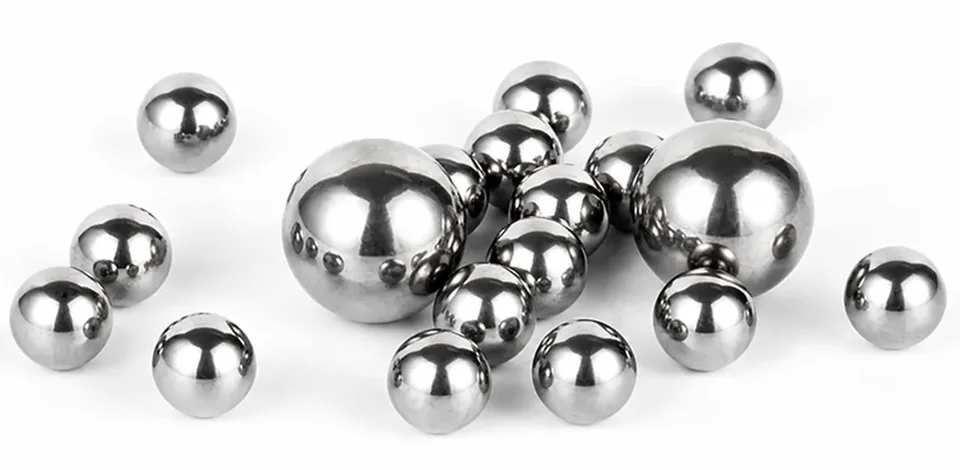 Stainless Steel Balls