
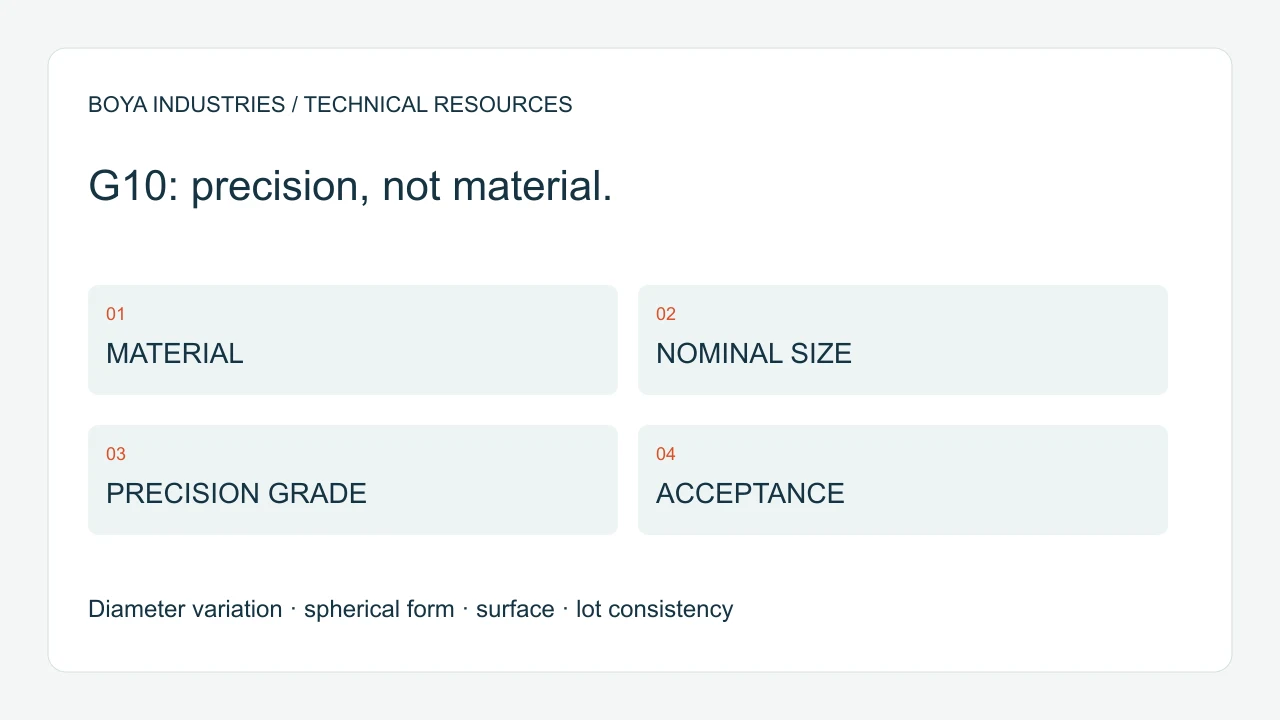
G10 is a precision grade used to classify finished steel balls.
For bearing manufacturers and industrial buyers, understanding this designation is important when preparing specifications and comparing supplier quotations.
However, G10 does not describe the steel material itself.
A complete steel ball specification requires both the appropriate material and the required precision grade.
G10 Is a Precision Grade, Not a Material Grade
Steel ball specifications often contain two different types of information.
The material designation describes the steel used to manufacture the ball.
Examples include AISI 52100, GCr15, and 100Cr6.
The precision grade, such as G10 or G20, describes dimensional and geometric quality requirements for the finished ball.
A buyer may therefore specify G10 steel balls manufactured from a particular bearing steel grade.
The two designations serve different purposes.
Which Characteristics Are Associated with Ball Precision?
ISO 3290-1:2014 specifies requirements for finished steel balls used in rolling bearings.
Relevant characteristics include:
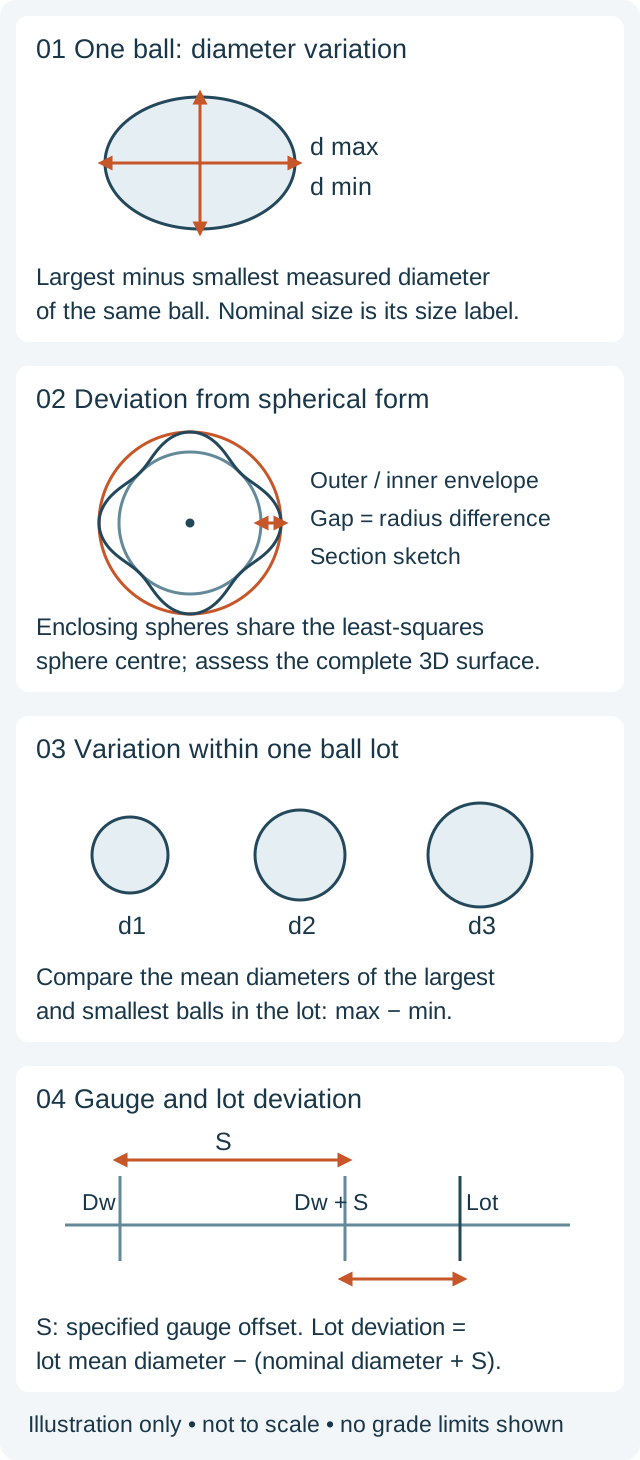
Ball Diameter Variation
Individual balls must satisfy the applicable dimensional variation requirements.
Diameter consistency matters when the balls are used in precision assemblies.
Deviation from Spherical Form
A precision steel ball should meet the applicable spherical form requirements.
Deviation from an ideal sphere is an important geometric consideration.
Surface Roughness
Surface texture is another characteristic included in steel ball precision requirements.
The applicable surface roughness limits and measurement requirements depend on the specified grade and standard.
Lot Consistency and Sorting
Ball lot variation and sorting requirements are relevant when purchasing large quantities of precision balls.
A buyer may also specify particular gauge or sorting requirements when the application demands them.
Does G10 Mean ±10 Micrometers?
No.
The number in the G10 designation must not be interpreted as a simple ±10 μm tolerance.
The grade is associated with several dimensional and surface characteristics, as defined by the applicable steel ball standard.
Buyers should consult the specified standard rather than assuming the grade number directly represents a single allowable size deviation.
G10 vs Other Precision Grades
Different applications may require different precision grades.
Selecting a grade should be based on the application, the engineering specification, and the requirements of the final assembly.
Choosing a numerically lower grade without considering the full technical and commercial requirements is not necessarily the right purchasing decision.
It is also important to remember that ball grade alone does not establish material suitability.
What Should Buyers Confirm?
Before ordering G10 chrome steel balls, confirm:
- Nominal ball diameter
- Required material grade
- Applicable precision standard
- Required ball grade
- Inspection and acceptance criteria
- Quantity, packaging, and documentation requirements
Clear specifications can prevent misunderstandings between buyers and suppliers.
G10 Chrome Steel Balls from BOYA Industries
BOYA Industries focuses on precision steel ball sourcing, including G10 chrome steel balls for bearing and industrial applications.
We work with experienced manufacturing partners in China to coordinate technical specifications, sourcing, and export supply.
Learn more on our G10 Chrome Steel Balls product page.
For an accurate quotation, please include your nominal diameter, grade, material, quantity, and inspection requirements.
BOYA’s featured sizes
G10 is our primary chrome steel ball grade, with G5 available on request through manufacturing partners. Featured sizes are 5/32 inch (approximately 3.9688 mm), 3/16 inch (4.7625 mm) and 1/4 inch (6.35 mm). Other diameters within 0.50–82.55 mm can be custom ordered, with the final supply specification confirmed in the quotation.
Four different precision concepts
Related purchasing guides
compare AISI 52100, GCr15 and 100Cr6